


Why Accepting Uncertainty Can Actually Reduce Anxiety
Learn why accepting uncertainty is one of the most effective ways to reduce anxiety and avoidance, and how ACT and ERP can help you build confidence.

If you’ve ever struggled with anxiety, you may have noticed that your mind really wants certainty. It wants to know you’ll make the right decision. It wants reassurance that nothing bad is going to happen. It wants answers before you take the next step.
The problem is that life doesn’t work that way.
No matter how much we think, research, prepare, or ask for reassurance, there will always be things we simply can’t know ahead of time. If only it were that easy.
Why We Try So Hard to Feel Certain
An anxious mind isn’t trying to make your life difficult. It’s trying to protect you.
When something feels uncertain, your brain starts scanning for information that might reduce the risk. Sometimes that’s helpful. Other times it turns into hours of researching, asking other people what they think, replaying conversations, or putting off decisions until we feel “ready.”
Those behaviors usually bring relief for a little while.
The catch is that they also teach your brain that uncertainty is something that needs to be escaped instead of experienced. Over time, your tolerance for uncertainty shrinks, and your anxiety grows.
Avoidance Isn’t Always Obvious
When people hear the word avoidance, they may picture a more common example like someone refusing to leave the house. Sometimes avoidance looks like that. It can often look more like what can be labeled as procrastination, excessive researching, asking others for their opinion (multiple times), and replaying conversations.
Examples of avoidance can be:
Waiting until you feel completely confident before trying something new.
Reading one more article before making a decision.
Asking someone, “What would you do?”
Checking your email one more time before sending it.
Replaying a conversation to figure out whether you said the wrong thing.
These behaviors make sense. They help us feel more certain for a moment. The problem is that they also keep us from learning something equally important: we can handle uncertainty better than our minds predict. Accepting uncertainity as part of the process helps reinforce that we can do something even if we are anxious.
Acceptance Isn’t the Same as Approval
Acceptance doesn’t mean you enjoy uncertainty or stop caring about the outcome. It means recognizing that uncertainty is part of every meaningful life. There is no relationship without uncertainty. No career change without uncertainty. No parenting, no healing, no growth, and no pursuing something you care about without some degree of not knowing.
Waiting until you feel completely certain will likely have you waiting forever.
Confidence Comes From Experience, Not Certainty
One of the biggest misconceptions about confidence is that confident people feel sure before they act. That’s simply not true. Confidence is usually built afterward. It develops every time you discover that you can tolerate discomfort, adapt when things don’t go according to plan, and recover from situations your mind once believed would be unbearable.
That’s one of the goals of therapies like Acceptance and Commitment Therapy (ACT) and Exposure and Response Prevention (ERP). The goal isn’t to convince yourself that everything will work out. It’s to learn that you can live a meaningful life even when you don’t know exactly how things will turn out. That’s a very different kind of confidence. Instead of asking, “How can I be certain this will work out?” You begin asking, “Can I make room for not knowing and still take the next step toward what I value?”
In my experience, that’s where people often start finding more freedom. Not because uncertainty disappears, but because it stops being the thing that’s making the decisions.

Do I have anxiety?
Anxiety doesn't always look like panic attacks. Sometimes it shows up as overthinking, perfectionism, avoidance, reassurance-seeking, or a constant need for certainty. Learn how anxiety can quietly shape your life and what it takes to break free from its cycle.
Anxiety can be a tricky experience to recognize. It’s easy to miss signs of anxiety when we’re only thinking of extremes or stereotypes. We might imagine panic attacks, chest pains, racing thoughts, or feeling so nervous we wouldn’t be able to function. Those can all be true, but anxiety is more than the obvious symptoms.
Anxiety also looks like overthinking every decision. Sometimes it looks like constantly seeking reassurance (repeating the same questions), procrastinating on important tasks, avoiding situations that feel uncomfortable, or spending hours preparing for things that might never happen. Others may experience anxiety as perfectionism, irritability, difficulty relaxing, trouble sleeping, physical tension, digestive issues, or a constant feeling that something is wrong even when they can't identify a specific problem. If these experiences happen so often that they become part of everyday life, some people may not recognize them as anxiety at all.
Instead, they may think:
"I'm just a worrier."
"I like to be prepared."
"I'm a Type A person."
"I've always been this way."
It’s okay to feel anxious sometimes. Anxiety is a normal human emotion. The real question is whether anxiety has started making your world smaller. Is anxiety getting in the way of living the life you want? Is anxiety preventing you from doing the things you enjoy, maintaining connection to others, or accomplishing life goals?
The Anxiety Trap
Feeling anxious isn’t the primary problem. It’s the choices we make in response to the feeling that causes issues. When something feels uncomfortable, our natural instinct is to avoid it. If social situations make us anxious, we stay home. If uncertainty feels unbearable, we search for answers. If a difficult conversation feels overwhelming, we put it off. If we doubt ourselves, we seek reassurance. In the short term, these strategies work. We feel relief. The problem is that our brain learns a powerful lesson: "That situation must have been dangerous if I had to escape it." It creates a feedback loop that can be hard to break. What began as a manageable discomfort can slowly expand into more areas of life.
That feedback loop often follows a predictable cycle:
A thought, feeling, or situation triggers anxiety.
We try to avoid, control, or eliminate the discomfort.
We experience temporary relief.
Our brain becomes even more convinced that the trigger is dangerous.
Anxiety returns stronger the next time.
This cycle can happen with generalized anxiety, social anxiety, health anxiety, perfectionism, phobias, and many other anxiety related struggles. To break the cycle, we have to change how we react to anxiety.
When Thoughts Feel Like Facts
One of the most frustrating things about anxiety is that it can make thoughts feel true simply because they are loud, repetitive, or emotionally charged.
You might notice thoughts like:
"Something bad is going to happen."
"I can't handle this."
"Everyone is judging me."
"What if I make the wrong decision?"
"I should wait until I feel more confident."
When we become fused with our thoughts, we stop seeing them as thoughts and start treating them as facts. The brain offers a prediction, and we respond as though the prediction is reality. Imagine standing at the edge of a swimming pool. If your mind says, "You'll embarrass yourself if you jump in," anxiety may convince you that embarrassment is not simply a possibility. It’s actually going to happen. The thought feels so real that it begins directing your behavior. This doesn't mean your thoughts are wrong. It means thoughts are not always evidence of what will happen. The French philosopher Michel de Montaigne wrote, “My life has been full of terrible misfortunes most of which never happened.”
One of the goals of therapy is learning to create a little more space between yourself and your thoughts. Instead of just asking, "Is this thought true?" we might ask:
Is this thought helpful?
What happens when I listen to this thought?
What happens when I make room for uncertainty instead?
When thoughts stop acting as unquestioned commands, we gain more freedom to choose our actions based on our values rather than our fears.
Building Confidence Instead of Certainty
One of the hardest parts of anxiety is the desire for certainty. We want to know everything will be okay before we take the next step. Unfortunately, life rarely offers that guarantee. Anxiety often asks us to wait until we feel safe enough, certain enough, or confident enough before we live our lives. The problem is that confidence rarely comes first. Confidence is usually built afterward through experience. Healing often involves learning how to move forward even when uncertainty is present. Instead of asking, "How do I get rid of this anxiety?" A more helpful question becomes: "How do I live the life I want while anxiety is here?"
Small Steps Create Lasting Change
Overcoming anxiety doesn’t mean becoming fearless. In reality, confidence is built through repeated experiences of doing something meaningful despite fear.
This might look like:
Making the phone call you've been avoiding.
Attending the event even though you feel nervous.
Driving the route that makes you anxious.
Setting a boundary that feels uncomfortable.
Allowing uncertainty instead of endlessly searching for reassurance.
Each time we do this, we teach our brain something new: "I can handle this." We don’t have to wait for the anxiety to disappear, because we learn that we are capable of moving through it. Over time, these small experiences help retrain the brain. The situations that once felt threatening become more familiar. We develop trust in our ability to cope even when discomfort is present.
You Don't Have to Figure It Out Alone
Anxiety can be exhausting. It can make the world feel smaller than it really is. We can lose sight of all the possibilities and choices we have. The good news is that anxiety is highly treatable. Through targeted anxiety therapy, and sometimes combined with medication if needed, many people learn to respond to anxiety differently, reduce avoidance, and reconnect with the parts of life that matter most to them. We don’t have to get rid of every anxious thought to overcome anxiety. It's about learning new ways to respond when those thoughts show up. It's about building flexibility, resilience, and trust in yourself.
If anxiety has been keeping you stuck, know that change is possible. Sometimes the first step is becoming curious about the patterns that have been running in the background for so long that you don’t even question them anymore.
Mood, Procrastination, and Executive Dysfunction: Why “Just Try Harder” Isn’t Working
Struggling with procrastination, low motivation, and feeling disorganized? Learn how ADHD, anxiety, depression, and stress can make simple tasks feel impossible. Executive dysfunction isn’t just being lazy and trying harder isn’t enough to fix it.
When Simple Tasks Feel Impossible
Do you ever say to yourself, “I know what I need to do. I just can’t make myself do it.” When we feel overwhelmed by our daily routine and responsibilities, this can lead to feeling guilt, shame, and the belief that we must be lazy, unmotivated, or somehow failing at adulthood.
What if the issue isn’t laziness? It could be executive dysfunction.
Executive dysfunction can show up with ADHD, but it also appears in depression, anxiety, trauma, grief, burnout, and chronic stress. Paying bills, answering emails, starting projects, returning texts, scheduling appointments, and cleaning the kitchen are all normal tasks in an average adult’s routine. None of these tasks are necessarily difficult, but they can feel mentally inaccessible.
When people just call this procrastination, they can miss what may be actually happening underneath it.
What Is Executive Dysfunction?
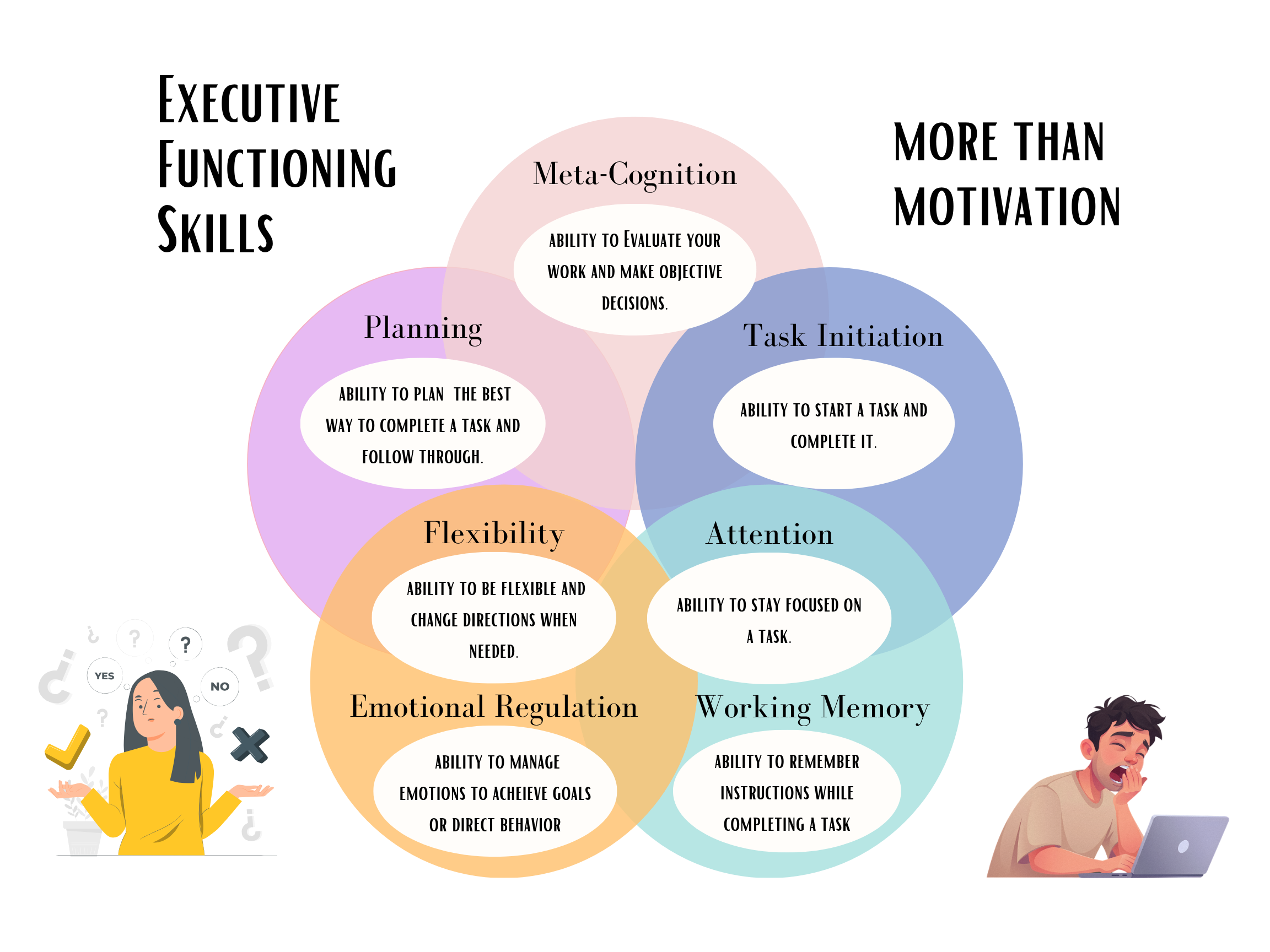
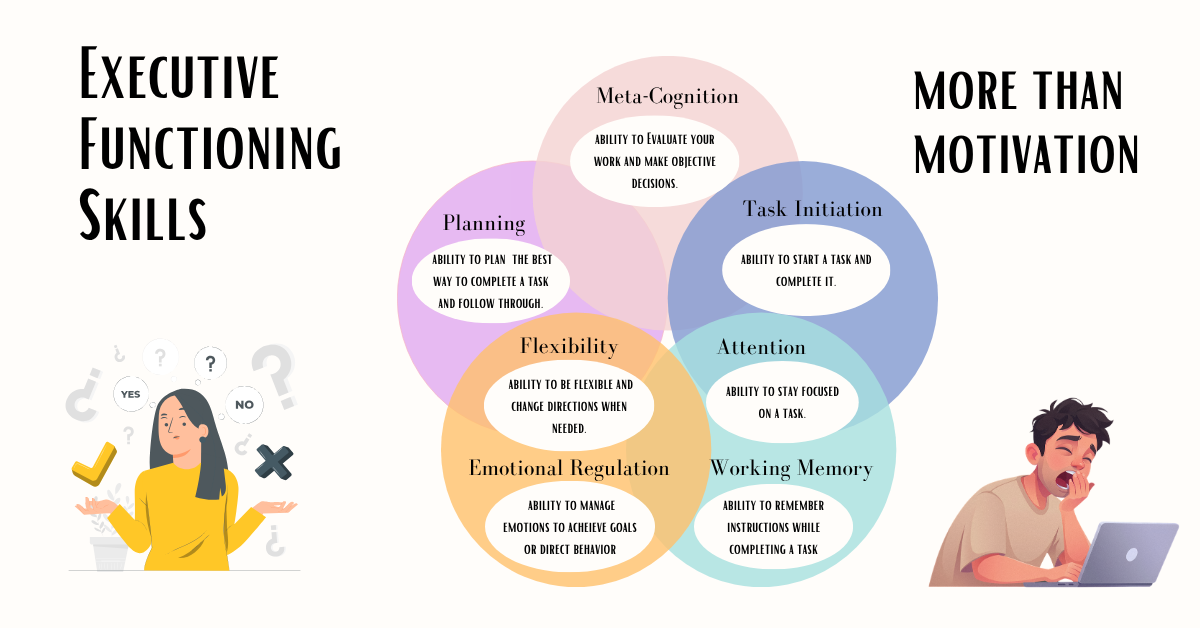
Executive functions refer to skills that you use to manage everyday tasks like making plans, solving problems, regulating emotions, and adapting to new situations
What do I need to get this done?
Executive functions are the brain’s management system. They help with:
Starting tasks
Prioritizing responsibilities
Managing time
Sustaining focus
Switching attention
Organizing information
Regulating emotions
Following through on plans
When these systems are overwhelmed or impaired, it creates a gap between intention and action. You may want to do the thing. You may even be anxious about not doing the thing. But your brain struggles to bridge the gap between knowing and starting. This is why procrastination can feel so confusing. It’s not always “I don’t care.” It can sound more like, “I care so much that I’m overwhelmed, frozen, and ashamed.”
Why Procrastination Feels So Personal
People struggling with executive dysfunction are often told they are careless, inconsistent, messy, lazy, or not living up to their potential. Over time, this becomes an internal story: I’m bad at life. That shame becomes its own barrier. Now the task isn’t just sending an email. It becomes proof of whether you’re competent. It isn’t just folding laundry. It becomes evidence of whether you’re failing. The emotional weight of the task gets bigger than the task itself. This is where procrastination becomes more than avoidance of folding your laundry and putting it away. It becomes avoidance of feeling anxiety, shame, or guilt.
Depression, Anxiety, and the Freeze Response
Sometimes executive dysfunction looks like distraction. Sometimes it looks like complete shutdown. You sit on the couch thinking about the thing for three hours. You scroll instead. You organize your planner instead of doing the actual task. You wait until panic creates enough urgency to force movement. This isn’t poor character. Sometimes it is ADHD. Sometimes it is depression draining your energy or anxiety making every decision feel high stakes. Sometimes it is grief, trauma, or burnout pushing your nervous system into survival mode.
When the brain perceives too much overwhelm, it shifts into fight, flight, freeze, or fawn. People can be experiencing chronic freeze without realizing it. They are not unmotivated. They are overloaded.
How to Work With Executive Dysfunction Instead of Against It
Healing procrastination usually starts by addressing the shame first and not just adding more pressure. Here are a few shifts that can help:
Make the task smaller than feels necessary
Don’t “clean the kitchen.” Put one plate in the sink. Starting creates momentum. The goal is activation, not perfection. Start with 10 minute tasks.
Externalize what your brain struggles to hold
Use sticky notes, visual reminders, timers, calendars, alarms, body doubling, and systems that reduce mental load. Support is not cheating.
Stop relying on motivation
Motivation is unreliable. Structure is kinder. Create routines that reduce decision fatigue instead of waiting to “feel like it.”
Notice emotional avoidance
Ask yourself: What feeling am I avoiding by not doing this? What if the answer is fear, shame, failure, overwhelm, or grief and not laziness?
Build self-trust slowly
Consistency matters more than intensity. Small follow-through rebuilds confidence faster than giant unsustainable plans.
Therapy for Executive Dysfunction, Anxiety, and Burnout
Therapy can help address the emotional side of executive dysfunction and not just the productivity side. This is because often the real work isn’t learning how to use a planner. It’s healing years of shame around feeling like you should be able to function differently. Treatment may include practical systems, emotional regulation skills, nervous system support, self-compassion, and understanding how your mood affects your ability to function. You do not need harsher discipline. You need strategies that actually fit your life.
Final Thought
If procrastination has made you feel broken, lazy, or behind, I want you to know this:
Struggling to start does not mean you do not care. You may just be overwhelmed. Executive dysfunction is real. Healing starts when we stop treating ourselves like a problem to fix and start building systems and routines that allow us to function with more compassion.
Looking for Therapy for ADHD, Anxiety, Depression, or Burnout?
At Diosa Mental Health, I work with adults navigating ADHD, anxiety, grief, depression, executive dysfunction, and the invisible weight of trying to keep it all together. Therapy can help you understand your patterns, reduce shame, and create practical tools that actually work. You do not need to perform wellness. You need support that meets you where you are, so you can start feeling like yourself again. You may never be a person who gets pumped about loading the dishwasher, but you can be a person who keeps your personal space tidy and takes care of yourself because you truly believe you deserve to have nice things and live a nice life. That’s the difference.

What I’m Reading This Spring: 4 Books on Healing, Nature, and Personal Growth
A therapist shares four powerful books on healing, nature, and the instinctual self. Explore Indigenous wisdom, plant teachings, and seasonal rhythms for nature-based well-being this spring.
Spring is in the air. Spring has a way of inviting us back into relationship with the earth, with rhythm, and with parts of ourselves that may have gone quiet during the winter months.
As the days lengthen and the soil warms, life begins to move again. We see it in budding trees, migrating birds, and the first flowers pushing through the ground. Nature reminds us that growth happens in cycles.
Lately, my reading has been reflecting this seasonal shift. The four books currently on my nightstand all explore themes of healing, connection to nature, and reclaiming inner wisdom. Each one, in its own way, offers guidance for returning to a more grounded and meaningful life.
Here are the books I’m currently reading this spring.
1. Indigenous Wisdom and Systems Thinking
One of the books I’m reading right now is Sand Talk by Tyson Yunkaporta.
This book explores Indigenous ways of understanding the world as interconnected systems instead of isolated parts. Yunkaporta, an Aboriginal scholar and member of the Apalech clan in Queensland, Australia, writes about patterns, relationships, and the wisdom embedded in traditional knowledge to create a better world.
A key theme of the book is that we cannot truly understand ourselves without understanding the systems we are part of: family, community, culture, and the natural world. This book frames a different way at looking at the sustainability of global systems.
In therapy, this perspective is powerful for people who feel overwhelmed by larger societal problems that feel too big for one person to change. Systems-level thinking takes a broader view for problem solving. Many struggles that people bring into therapy such as anxiety, burnout, and disconnection often emerge when we feel cut off from these deeper systems of belonging.
Spring reminds us that we are not separate from nature’s cycles or the world in which we live. We are active participants. Remembering that can hold a lot of power in how we choose to live and engage.
2. What Plants Can Teach Us About Healing
Another book I’m revisiting this season is Braiding Sweetgrass by Robin Wall Kimmerer.
Kimmerer, a botanist and member of the Citizen Potawatomi Nation, blends science and Indigenous wisdom to explore what plants can teach us about reciprocity and gratitude.
One of the central ideas in this book is that the natural world operates through mutual care and relationship. Plants, animals, soil, and humans are all part of a living exchange.
This perspective can be deeply healing.
In therapy, we often discover that personal growth doesn’t happen through pressure or force. Like plants, people grow best when the conditions support them. Key features we need for our own optimal growth conditions are safety, connection, curiosity, and compassion.
What we plant in the darkness of soil will eventually push through and grow towards the light. Spring is the perfect reminder that growth takes time.
3. Ancestral Healing and Ritual
Another book currently on my reading list is The Curanderx Toolkit by Atava Garcia Swiecicki.
This book explores traditional Latinx healing practices such as herbal medicine, energy cleansing, ritual, and ancestral connection.
Many traditional healing systems understand wellness as balance between the mind, body, spirit, community, and the earth.
Modern therapy increasingly recognizes this truth as well. I view emotional healing as more than just a cognitive process. It often involves reconnecting with the body, honoring cultural identity, exploring family legacy, and restoring meaning in our lives.
Spring has long been associated with cleansing and renewal across cultures. It’s a time when many traditions engage in rituals that help release the old and welcome new beginnings.
4. Reclaiming the Wild Instinctual Self
Finally, I’ve returned to the classic Women Who Run With the Wolves by Clarissa Pinkola Estés, Ph.D.
This beloved book explores myths and folktales that illuminate the wild woman archetype of the instinctual, intuitive core that exists within every woman.
Dr. Estés, a Jungian-trained psychoanalyst, describes how many women lose connection with this instinctual self through trauma, cultural expectations, or chronic self-doubt.
The stories in this book help readers reconnect with intuition, creativity, emotional depth, and inner knowing.
In many ways, this mirrors what happens in therapy: a process of remembering who we are beneath the roles, expectations, and survival patterns we’ve developed over time.
Spring often awakens this instinctual energy. After a long inward winter, something within us begins to stretch toward life again.
Therapy and the Seasons of Life
One of the things I often discuss with clients is that healing doesn’t happen in a straight line. It unfolds in cycles much like the seasons in nature.
There are seasons for:
Winter – rest, grief, reflection
Spring – renewal, curiosity, new beginnings
Summer – growth, connection, vitality
Autumn – integration, letting go, transition
Many people feel pressure to always be growing or improving, but nature shows us that every season has its purpose.
Sometimes healing begins simply by learning to honor the season we are in.
Spring doesn’t force the flowers to bloom. It simply creates the conditions where growth becomes possible.
Therapy can offer something similar as a supportive space where healing unfolds at its own pace.
Listening to Your Own Season
Spring reminds us that change rarely happens all at once. Growth begins quietly beneath the soil in places we can’t immediately see.
Sometimes the first sign of change is simply a feeling: a sense that something inside you wants to grow, shift, or be understood more deeply.
Therapy can be a place to explore that process.
Just as the natural world moves through seasons of rest, renewal, and transformation, our inner lives often follow similar rhythms. Having a supportive space to reflect, process emotions, and reconnect with yourself can make those transitions feel less overwhelming and more meaningful.
“Sweetgrass is best planted not by seed, but by putting roots directly in the ground. Thus the plant is passed from hand to earth to hand across years and generations. Its favored habitat is sunny, well-watered meadows. It thrives along disturbed edges.” - Braiding Sweetgrass, Robin Wall Kimmerer
Frequently Asked Questions About Healing, Nature, and Spring Renewal
Why does spring affect our mental health?
Seasonal changes can influence mood, energy, and motivation. Longer daylight hours, warmer weather, and increased time outdoors can support improved mood and emotional renewal. For many people, spring naturally brings a desire for change, growth, and reconnection.
Can nature help with emotional healing?
Research increasingly shows that spending time in nature can reduce stress, support emotional regulation, and increase feelings of wellbeing. Many therapeutic approaches incorporate nature, mindfulness, and grounding practices because they help people reconnect with their bodies and the present moment.
Why do seasonal rhythms matter for mental health?
Human beings evolved in relationship with natural cycles. Just as the earth moves through seasons of rest, growth, fullness, and release, our emotional lives often follow similar rhythms. Honoring these cycles can reduce pressure to always be productive and instead allow space for rest, reflection, and renewal.
What are good books about healing and reconnecting with yourself?
Some powerful books that explore healing, nature, cross-cultural perspectives, and personal growth include
Sand Talk by Tyson Yunkaporta
Braiding Sweetgrass by Robin Wall Kimmerer
The Curanderx Toolkit by Atava Garcia Swiecicki
Women Who Run With the Wolves by Clarissa Pinkola Estés, Ph.D.
These books explore Indigenous wisdom, plant teachings, ancestral healing traditions, and the instinctual self.

The Miracle Berry Effect: How Accepting Grief Creates a Fuller Life
Discover how embracing grief, like the miracle berry transforms sour into sweet, can expand your capacity to feel deeply, build resilience, and experience life fully despite experiencing loss.
“I am not suggesting that we live a life preoccupied with sorrow. I am saying that our refusal to welcome the sorrows that come to us, our inability to move through these experiences with true presence and conscious awareness, condemns us to a life shadowed by grief. Welcoming everything that comes to us is the challenge. This is the secret to being fully alive.”
― Francis Weller, The Wild Edge of Sorrow: Rituals of Renewal and the Sacred Work of GriefThe Miracle Berry Effect: A Lesson from Nature
Synsepalum dulcificum, commonly called the miracle berry or miracle fruit, is a tropical shrub native to West Africa that produces small red berries. Eating these berries temporarily changes your taste perception: a sour lemon tastes sweet. The lemon itself doesn’t change; it’s your perception that shifts (Pallathadka, 2024).
Grief works like the miracle berry. The pain doesn’t disappear, but our perception and experience of life alongside it can shift.
Accepting sorrow holds the paradox of allowing us to feel more deeply. Loss doesn’t vanish, but embracing it allows life’s richness to coexist with grief.
Grief Is Part of Being Human
Grief is not a sign something is wrong. It shows that you loved deeply and that you are human.
When we resist grief, we use avoidance as protection from pain:
We push it away or numb ourselves.
We distract ourselves with work, screens, or other obligations.
We judge ourselves for feeling what we feel.
When we allow grief to be what it is and accept the reality of the loss, our experience begins to change. Loss does not become easy. Love does not disappear. What can change is our willingness to feel what is real. Healing is not the absence of grief. It is having the capacity to experience life fully, even when grief is present.
When we stop fighting grief and allow it to move in its natural rhythms, we often discover that sorrow can exist alongside warmth, memory, meaning, and even moments of sweetness. Grief doesn’t move in a straight line, and it doesn’t keep a tight schedule. We move through it at the pace that is natural to us.
Grief as a Process, Not a Problem to Fix
Grief is not a single emotion or a linear timeline. Two well-established models help normalize the grieving experience:
The Four Tasks of Mourning (Worden, 2009)
Grief involves:
Accepting the reality of the loss
Processing the pain of grief
Adjusting to a world that has changed
Finding a lasting connection while continuing to live
💡 Tip: These tasks aren’t “steps to complete.” They are experiences you return to again and again, often in different ways.
The Dual Process Model of Grief (Stroebe & Schut, 1999)
Healthy grieving involves moving back and forth between:
Loss-oriented experiences: crying, remembering, missing, feeling the pain
Restoration-oriented experiences: working, connecting, laughing, planning, resting
💡 Tip: There is no “correct balance.” Grief naturally ebbs and flows. Our goal is adaptive coping.
Healing Is Not the Absence of Grief
Grief is a natural part of life. Loss comes in many forms:
Death of a loved one
The end of a relationship
An unexpected diagnosis
A future we didn’t imagine
Like the miracle berry, accepting loss doesn’t remove life’s bitterness. Instead, it lets us metabolize grief, take in the full spectrum of experience, and use what it teaches us to keep living. When we are intentional about processing grief, it can expand our capacity to feel deeply, cultivate gratitude, and build resilience.
💡 Tip: Allow grief to move at your own pace. There is no right timeline.
References
Pallathadka, H. (2024). Miracle Berry (Synsepalum dulcificum): A Comprehensive Review of Bioactive Properties, Mechanisms, and Future Applications in the Post Synthetic Sweetener Era. International Research Journal of Education and Technology, 6(11), 508–532. https://doi.org/10.70127/irjedt.vol.8.issue05.532
Stroebe, M., & Schut, H. (1999). The Dual Process Model of Coping with Bereavement: Rationale and Description. Death Studies, 23(3), 197–224. https://doi.org/10.1080/074811899201046
Worden, J. W. (2009). Grief counseling and grief therapy: A handbook for the mental health practitioner (5th ed.). Springer Publishing Company.

Emotional Regulation Is Not About Accepting the Unacceptable
Emotional regulation is everywhere right now and often associated with nervous system regulation when discussing coping skills. We’re told to breathe, ground, calm down, and self-soothe. Nuance is important here. What should we do in moments when what we’re reacting to is actually wrong?
For many people, especially those experiencing moral injury, collective grief, abuse, or systemic harm, this raises an important question:
Is regulation meant to help us face reality or to help us tolerate what shouldn’t be tolerated?
The answer matters.
What Emotional Regulation Is Actually For
Emotional regulation is about understanding and managing your emotions in a healthy way while restoring a felt sense of safety in the body (Cleveland Clinic, 2023). It’s meant for resourcing skills that help us increase capacity for distress tolerance. This helps us to move through our emotions and stay connected to our authentic selves even during challenging times. It is not intended to erase emotions or override values.
Emotional regulation is often associated with your autonomic nervous system due to the sympathetic and parasympathetic nervous systems’ response to stress and danger. When the the body shifts into survival states, it will show up as:
fight (anger, urgency)
flight (anxiety, restlessness)
freeze (shutdown, numbness)
fawn (appeasing, minimizing)
In these states, it becomes harder to think clearly, access choice, or respond in ways aligned with our values.
Regulation helps the body come out of survival mode so we can engage with reality more effectively and not escape it.
Regulation vs. Dissociation
There’s an important difference between regulation and dissociation, even though they can look similar from the outside (Beutler et al., 2022).
Regulation:
increases presence and awareness
allows emotions to be felt without overwhelm
expands capacity to act, decide, or set boundaries
supports clarity and agency
Dissociation:
numbs or disconnects from experience
reduces awareness of emotions or bodily signals
makes it easier to tolerate harm
often comes with collapse or resignation
If a “calming” practice leaves you feeling smaller, checked out, or resigned to something that violates your values, autonomy, or safety, that’s not regulation. It’s a protective shutdown and function of your autonomic nervous system.
When “Calm Down” Becomes a Problem
Immediately telling ourselves or others to regulate can unintentionally send the message:
Your reaction is the problem.
Your anger is too much.
You should be more accepting.
For people facing injustice, boundary violations, or ongoing harm, this can feel invalidating and possibly cause further harm.
The goal of regulation is not to make you compliant. It’s to help your body feel safe enough to respond, not just endure.
A Trauma-Informed View: Safety First, Then Choice
From a trauma-informed perspective, regulation is a resource, not a moral instruction or a quick fix to a complex problem.
When the body feels safer:
anger can become information rather than explosion
grief can be felt without collapse
fear can coexist with courage
values can guide action instead of survival reflexes
This is especially important for people navigating complex issues that need sustained effort to see change. Regulation helps prevent burnout by supporting sustainable engagement.
Using Regulation to Face What’s Hard
Regulation is most effective when it’s used before or during difficult engagement and not as a way to opt out.
Examples:
grounding so you can have a hard conversation
orienting so you can read the news without shutting down
breathing to stay present while setting a boundary
resourcing so anger can be expressed clearly, not destructively
In these moments, regulation increases capacity. It doesn’t erase the problem, but it can help you meet it.
When Regulation Becomes Bypass
Regulation turns into bypass when it’s used to:
talk yourself out of anger that signals injustice
accept harm you actually want to resist
stay calm instead of setting necessary boundaries
avoid grief that needs witnessing
If a practice consistently leads to passivity, resignation, or self-blame, it’s worth getting curious about what part of you is being protected and what’s being silenced.
Regulation and IFS: Working With, Not Against, Your Internal System
IFS is a therapeutic model that compliments emotional regulation work. In Internal Family Systems (IFS), regulation isn’t about controlling parts. It’s about helping them feel safe enough to unblend.
Protective parts that push calming strategies may be trying to prevent overwhelm, conflict, or danger. That intention matters.
IFS helps:
distinguish safety from suppression
create space for curiosity where emotions can inform action
restore internal leadership rather than collapse
increase your ability to have compassion for yourself and integrate the parts of you that feel conflicted, so you can respond with clarity instead of shame and overwhelm.
Regulation becomes a way to stay in relationship with yourself while navigating a difficult world.
You Don’t Need to Be Calm to Be Right
There are situations where anger, grief, and urgency are appropriate responses.
The work is not to eliminate these states but to help the body tolerate them without losing agency or self-trust.
Emotional regulation should help you:
feel safer in your body
think more clearly
act more intentionally
stay connected to what matters
Not accept the unacceptable.
A Final Note
If regulation tools have ever made you feel disconnected, silenced, or “too calm” in situations that called for action, that doesn’t mean you failed. It may mean your system needs support that honors both safety and truth. Therapy can help untangle that difference and help you build capacity to face hard realities without abandoning yourself. This work can also be done outside of therapy within your chosen community of trusted support people and in taking time to be alone to explore your needs and honor what you find in the stillness.
People with extensive trauma histories, diagnosis of PTSD, or history of self-harm and suicidal ideation should engage in emotional regulation work with a licensed mental health professional. If therapy is not accessible to you right now and you are feeling overwhelmed, you can also refer to the free support lines I have listed here.
References:
Beutler, S., Mertens, Y. L., Ladner, L., Schellong, J., Croy, I., & Daniels, J. K. (2022). Trauma-related dissociation and the autonomic nervous system: a systematic literature review of psychophysiological correlates of dissociative experiencing in PTSD patients. European Journal of Psychotraumatology, 13(2). https://doi.org/10.1080/20008066.2022.2132599
Cleveland Clinic. (2023, June 9). Emotional dysregulation: How to feel about managing feelings. Cleveland Clinic. https://my.clevelandclinic.org/health/symptoms/25065-emotional-dysregulation

Moral Injury and Collective Grief: When the World Breaks Our Sense of Right and Wrong
Moral injury and collective grief are rising amid systemic injustice. If you find yourself overwhelmed by sadness, anger, or moral despair in response to what you’re seeing and hearing, it doesn’t mean something is broken in you. It means you are human and attentive to suffering and injustice. Therapy can be a space where moral pain and collective grief are named, honored, and held with care, rather than minimized or medicalized.
Many people coming into therapy right now aren’t just anxious or depressed. They’re grieving something harder to name. They’re grieving the loss of trust in systems that were supposed to protect people. They’re grieving the harm done to communities they love. They’re grieving a world that feels increasingly out of alignment with their values.
This experience is often described as collective grief, and for many, it overlaps with something called moral injury.
What Is Moral Injury?
Moral injury occurs when a person witnesses, participates in, or is unable to prevent actions that violate their deeply held moral or ethical beliefs.
Originally studied among military veterans, the concept of moral injury has expanded to include:
Healthcare and mental health providers
Social workers and educators
Activists and organizers
Marginalized communities facing systemic harm
Anyone repeatedly exposed to injustice, violence, or institutional betrayal
Moral injury is not a mental illness. It’s a human response to ethical rupture.
People experiencing moral injury often report:
Deep anger or betrayal
Guilt or shame (“I should have done more”)
Loss of faith in institutions or leaders
Emotional numbness or exhaustion
A fractured sense of meaning or purpose
Collective Grief: Mourning in Community
Collective grief is the shared emotional response to large scale loss. Loss of life, safety, rights, stability, or a sense of hope for the future are all examples of what can cause collective grief.
Unlike personal grief, collective grief is often:
Ongoing rather than time-limited
Re-triggered by news cycles and social media
Minimally acknowledged or ritualized
Politicized or dismissed
When grief is unrecognized, it tends to go underground showing up as burnout, despair, rage, or withdrawal.
How Moral Injury and Collective Grief Intersect
Moral injury and collective grief often reinforce each other.
When people repeatedly witness harm and feel powerless to stop it, grief becomes moralized:
“This shouldn’t be happening.”
“Someone should be held accountable.”
“What does it say about us that this continues?”
Over time, the nervous system may shift into survival mode, hypervigilance, shutdown, or chronic overwhelm, while the psyche wrestles with meaning, responsibility, and hope.
Why These Phenomena Are More Visible Right Now
Recent national events have highlighted how moral injury and collective grief operate not only in private but in public life. For many people, watching or learning about situations where vulnerable individuals, especially children and law-abiding citizens, are harmed by systems meant to protect them triggers deep emotional responses. For example:
In Minnesota, a federal immigration enforcement operation has escalated tensions in Minneapolis and surrounding communities. In early January, an ICE agent fatally shot a local resident, Renée Good, during an enforcement action, sparking widespread protests and questions about use of force by federal agencies.
Yesterday on January 24, 2026, another resident, Alex Pretti, was killed in a separate shooting involving federal agents, igniting further outrage and community distress.
During the same operations, federal immigration agents detained several children, including a 5-year-old boy returning from preschool and other students, in Columbia Heights and Minneapolis area school districts. Educators and community members described these detainments as traumatic and destabilizing.
These events have not only made national headlines but have touched the emotional and moral lives of people far beyond Minnesota. When communities see repeated setbacks such as loss of life, separation of families, and erosion of trust, they grieve not only the individuals harmed but also the values they believe society should uphold.
Why “Just Coping Skills” Aren’t Enough
For moral injury and collective grief, the problem isn’t poor resilience or distorted thinking.
The problem is exposure to real harm.
While grounding skills can help regulate the nervous system, healing also requires:
Naming injustice without minimizing it
Making space for anger, grief, and disillusionment
Reconnecting with values rather than bypassing them
Finding meaning, agency, or witness in community
Therapy that ignores the social context can unintentionally deepen shame or self-blame.
What Healing Can Look Like
Healing from moral injury and collective grief doesn’t mean becoming indifferent or “less affected.”
It can mean:
Learning how to carry grief without being consumed by it
Reclaiming moral clarity without burning out
Separating responsibility from impossibility
Developing sustainable ways to stay engaged with the world
Approaches such as trauma-informed therapy, IFS Therapy, Acceptance and Commitment Therapy, and Mindfulness- Based Stress Reduction can help people process these experiences with compassion rather than collapse.
How Moral Injury and Collective Grief Live Inside Us
Moral injury and collective grief don’t stay abstract—they live inside the nervous system and the psyche.
People often notice:
One part of them feels furious and wants accountability
Another part feels helpless, shut down, or numb
Another part feels guilty for needing rest or joy
Another part wants to disengage entirely to survive
This internal conflict can be exhausting and confusing, especially when people believe they’re “supposed” to cope better.
How Internal Family Systems (IFS) Therapy Helps
Internal Family Systems (IFS) therapy offers a powerful, compassionate way to work with moral injury and collective grief without pathologizing normal human responses to injustice.
IFS understands the mind as made up of different parts, each with its own role and intention. In the context of moral injury and collective grief, parts often include:
Protective parts that use anger, activism, withdrawal, or numbing to prevent overwhelm
Exiled parts that carry grief, fear, despair, or heartbreak about what has been lost
Critical parts that shame us for resting, disengaging, or feeling hopeless
Rather than trying to eliminate these responses, IFS helps people:
Understand why each part exists
Unburden parts from carrying impossible responsibilities
Make space for grief without being consumed by it
Restore access to compassion, clarity, and grounded agency
IFS is especially helpful for moral injury because it:
Honors moral pain instead of reframing it away
Separates responsibility from impossibility
Allows people to stay values-aligned without burning out
Helps rebuild internal trust after institutional betrayal
Healing Without Becoming Numb
Healing moral injury and collective grief does not mean becoming indifferent, detached, or “less affected.” It means learning how to stay present with pain without collapsing under its weight.
Through trauma-informed approaches like IFS, people can:
Carry grief with dignity
Stay connected to values without self-destruction
Find sustainable ways to remain engaged with the world
Reclaim meaning and inner leadership
You Are Not Broken for Feeling This Way
If you feel heavy, angry, tired, or hopeless in response to the world right now, it does not mean something is wrong with you. It may mean you are paying attention and feeling the weight of sorrow. You don’t have to carry it alone.
If you’d like support in processing moral injury, collective grief, or the emotional impact of systemic injustice, therapy can be a space where your values are honored and not pathologized.